Saving History, One Beam at a Time
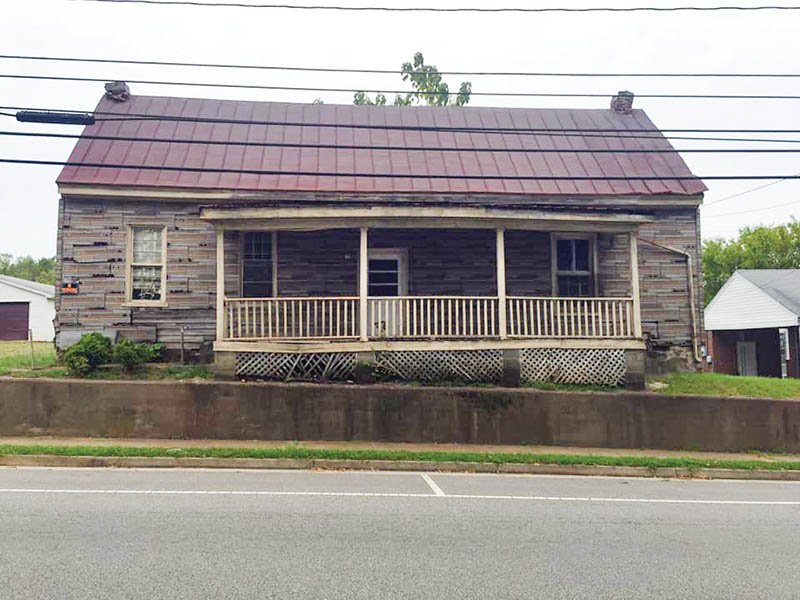
Every small town has its ghosts. In Halifax, one of them was the Banister Town Tavern—an unstable and uninhabitable 18th-century inn whose walls once sheltered travelers, debates, and dreams of revolution. When the structure’s timbers began to fail, most assumed its story had ended. But local preservationist Christopher “Todd” Hunley saw something different: a chance to keep a piece of Virginia’s past standing, one beam at a time.
Those local to Lynchburg know Hunley as the face behind the counter at Buzzard’s Roost Antiques, the antique shop that he and his wife own and operate. But Hunley wears many proverbial hats—historian, antique collector and shop owner, Sheriff First Sergeant with the City of Lynchburg, and doting father to a six-year-old son.
Hunley has always wanted to live in a Federal-style period home. He has also always wanted to live on his property in Pittsylvania County.
“But my property doesn’t have a Federal period home on it,” Hunley laughed, “so my only solution was to bring an old house to my property.”
So that is exactly what Hunley is doing.
Hunley had been vocal about his interest in finding a Federal-period home to live in, renovate, or disassemble and move, so when friends caught wind of the fate of the Banister Town Tavern—also often referred to as Bell Tavern—in the Town of Halifax, they immediately called Hunley.
“The home had become extremely unstable,” he said. “If I hadn’t done this with the Town of Halifax, the tavern would have met the fate of the bulldozer.”
Hunley toured the Banister Town Tavern. He took in its weathered pine boards, its leaning timbers, its overgrown lots.
“It wasn’t a candidate for restoration,” Hunley said. “The sills were rotted through, the basement had been backfilled to avoid structural collapse.”
Hunley made an offer to the Town of Halifax, which included a detailed plan to disassemble the tavern and move the materials 48 miles away to his property. The Town of Halifax accepted, seeing Hunley’s proposal as a way to preserve the structure without losing its story.

“That little house still had life in it,” Hunley said. “It played a vital part during such an instrumental time in our country…and I couldn’t let it disappear.”
Much of the tavern’s history has been lost to time, but the house, as Hunley refers to it, was originally Banister Town Tavern, with Banister Town being the settlement in that area before Halifax was established. Originally constructed between 1760 and 1770, with an addition added in the early 1800s, it’s estimated that Banister Town Tavern was once a bustling establishment.
In the mid- to late-1700s, what is today Route 501 was a main stagecoach route for those venturing from New York to New Orleans, so it was common for taverns to be peppered throughout the route to meet the demands of the stagecoach travel. According to Hunley, horses could only travel a maximum of 30 miles per day, so many stops were essential along the way.
“Most people today think a tavern was just a bar,” Hunley explained. “But in the 18th century, a tavern was the heartbeat of a community.”
The Banister Town Tavern functioned as a lodging house, meeting place, and community hub. It would have been a place for respite, a meal, and a place for horses to be rested and watered.
“Local folklore claims that George Washington may have stopped there, but of course that is just legend—there is no physical proof that it happened, but it is certainly plausible,” he said.
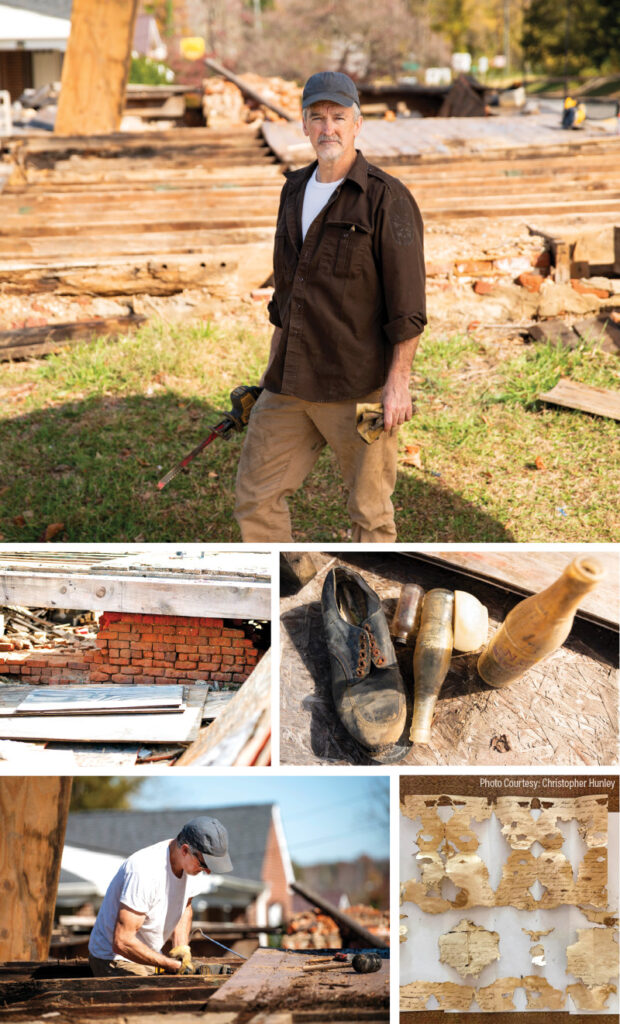
When Hunley began disassembling the tavern, he found a letter written in 1823—mouse-eaten and in tatters—from a brother to his sister, who was living in the tavern. He also found a rosette in the same wall that would have been from a uniform from the War of 1812.
“I was really hoping to find artifacts left behind,” Hunley said. “Tons of stuff were in the walls from the 1980s, which was the last time the house was lived in. But I still haven’t gotten into the basement, so I’m hopeful to find artifacts from when the house was first built.”
For Hunley, the dismantling was an act of both preservation and patience. The home had waited long enough. Now it was time to save what was left.
Dismantling the tavern, to say the least, has not been easy. To date, Hunley has removed 70 tons of plaster, lath, and debris, all of which has been removed by hand in an effort to save as much of the original material as possible. On estimate, Hunley has saved 70 percent of the main structure and 85 percent of the addition. The timbers that aren’t structurally sound enough to be reassembled as his home will be repurposed for out buildings, such as a traditional smokehouse.
“Rebuilding this tavern isn’t cheaper than building something new,” he said. “But the materials tell a story that you can’t replicate today.”
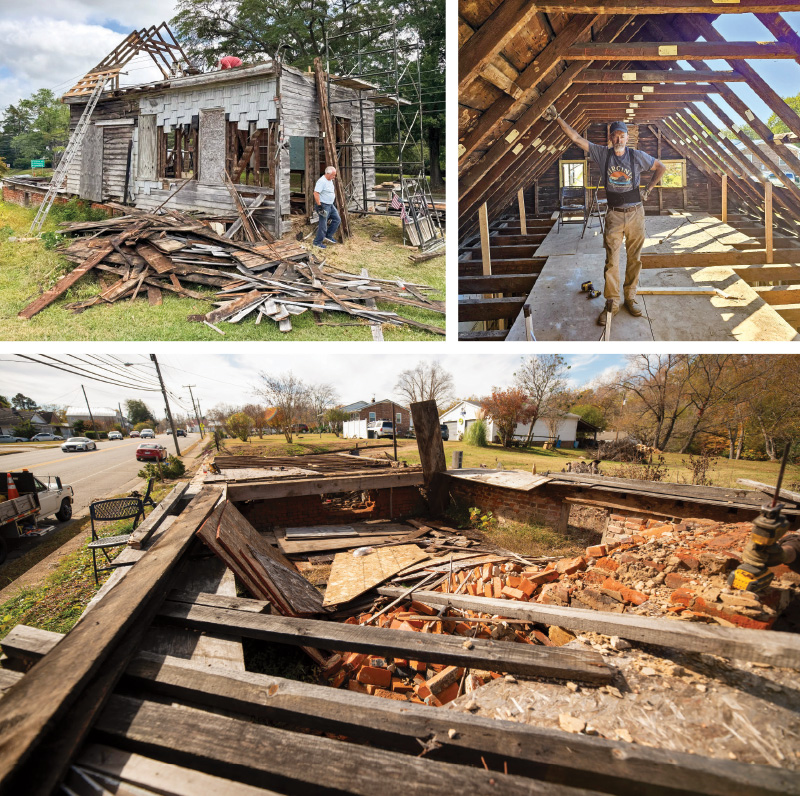
Hunley’s passion for history runs deep—fueled by a lifelong fascination with the tangible past and the belief that every artifact, no matter how weathered, has something to teach us. He’s meticulously documenting the entire process of the tavern’s dismantling and reconstruction, not only as a guide for the rebuild but as a record of its continued life.
“I’m preserving this for the same reason I collect antiques,” he said. “These things tell the story of who we are. If we don’t take the time to understand where we came from, we lose part of ourselves.”
The project has also become a kind of inheritance. Hunley often says that while the tavern may one day stand on his land, it doesn’t really belong to him—it belongs to the continuum of history, to the people who built it, and to those who will stand inside it long after he’s gone. Each board he saves, each joint he restores, keeps a connection alive between past and present.
For the Town of Halifax, the partnership represents a rare success story—proof that preservation doesn’t always mean leaving something in place. It can also mean giving it the chance to live again.
“The town has been incredible,” Hunley said. “They didn’t want to see this piece of history lost, and neither did I.”
When the Banister Town Tavern rises once more—this time among the rolling fields of Pittsylvania County—it will stand as a testament to resilience, craftsmanship, and the enduring pull of stories worth saving.
More than two centuries after it first opened its doors, the Banister Town Tavern is traveling again—carried beam by beam, memory by memory, toward a new beginning. And like the generations who once passed through its halls, it’s bound not by where it stands, but by the history it keeps alive.